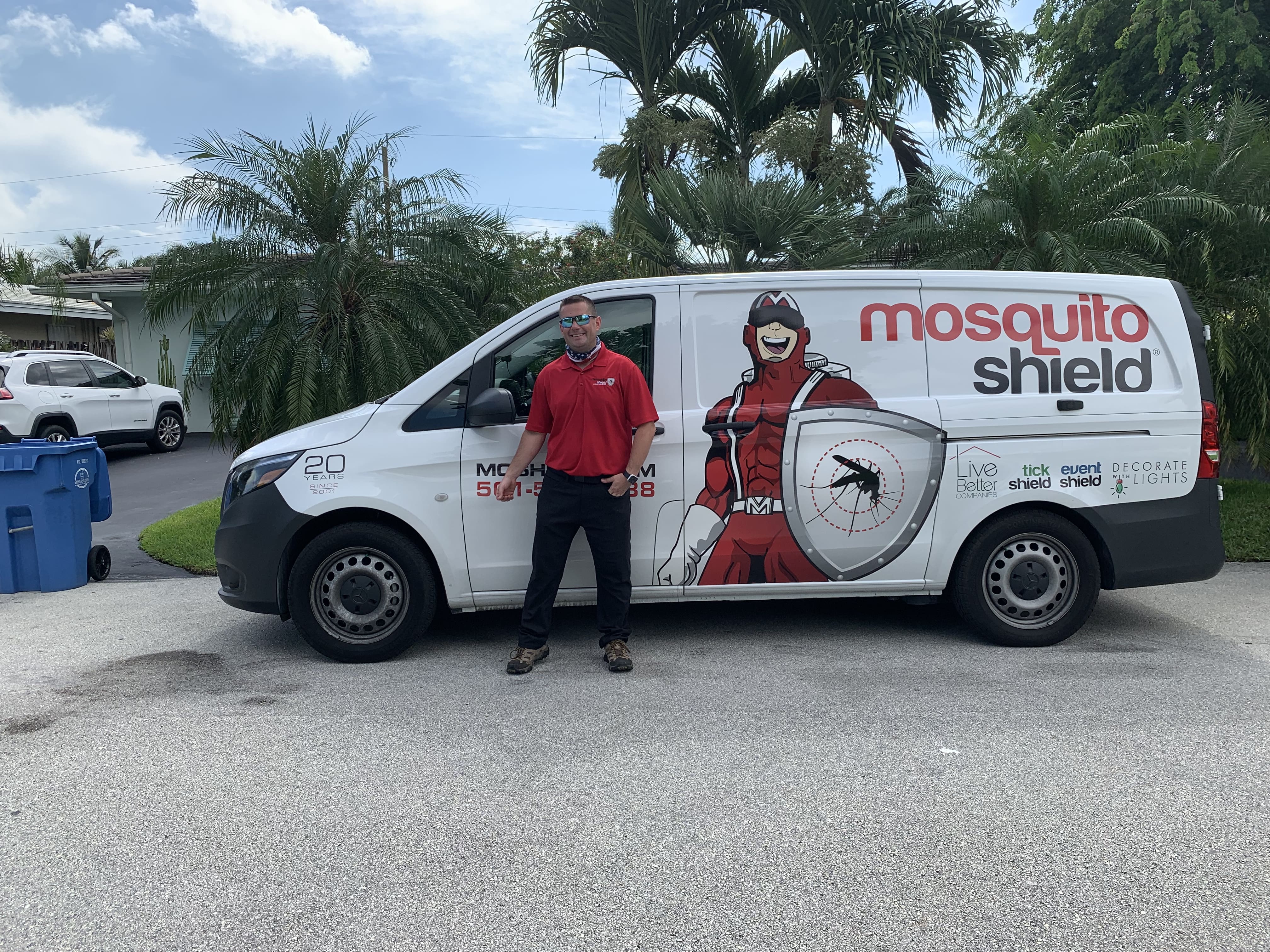
Eric holds a degree in Pest Control Technology from the University of Florida and carries all five Florida pest control license categories: General Household Pest, Rodent, Lawn & Ornamental, Wood Destroying Organisms, and Public Health (License JB313837). He personally developed Mosquito Shield's proprietary Mosquito Protection Blend and has been treating South Florida properties for over a decade. When he is not in the field, he is behind every piece of content on this site.
Pet safety is the first question most South Florida pet owners ask before starting mosquito service — and it is the right question. As a licensed pest control operator who has treated thousands of homes with dogs, cats, and backyard ponds, I want to give you an honest, species-specific breakdown instead of a generic reassurance.
What Is In Our Formula
Our Mosquito Protection Blend (MPB) is a proprietary botanical formula developed after years of field testing in South Florida conditions. The primary ingredients are plant-derived:
Derived from lemongrass. No re-entry risk for dogs and cats at label application rates. Repels by scent.
Culinary herb. Strong long-residual repellent. Non-toxic to mammals.
High menthol content disrupts mosquito mating cycles. No re-entry risk for pets once dry.
Plant-derived. Targets insect respiratory systems. Non-toxic to mammals at application concentrations.
Alcohol compound found in rose oil. Effective larvicide. No re-entry risk for cats and dogs at label concentrations.
A permethrin-class component at less than one shot glass per treatment. This is the ingredient that requires the drying window for cats specifically.
Pet-by-Pet Safety Guide
Dogs can return to the yard 15 to 30 minutes after treatment once the product has dried. The botanical-forward formula is well-tolerated by dogs. Do not allow dogs to lick treated vegetation while wet. We do not treat areas where dogs eat or drink. For dogs with known skin sensitivities, ask us about our treatment zones during scheduling.
Cats metabolize certain compounds differently from dogs. They are sensitive to permethrin-class ingredients because they lack the glucuronyl transferase enzyme needed to break these down. For cat households, we recommend a 45-minute drying window, ensuring cats cannot groom treated outdoor surfaces while wet, and keeping cats indoors during treatment. If you have an outdoor cat that is difficult to keep inside, discuss this with us before scheduling.
We never treat over water. Before your first visit, we map all water features on your property and create a buffer zone around ponds, water gardens, and fountains. Fish and aquatic life are very sensitive to pesticide runoff, and we take this seriously. If your pond is adjacent to treated areas, the physical application method (directed foliage spray, not broadcast) combined with drying time eliminates runoff risk.
Birds are generally more resilient to our formula than reptiles or fish. We do not treat bird feeders, bird baths, or active nest sites. The primary concern with birds and pesticides is secondary poisoning through the food chain. Since our formula targets mosquitoes rather than their food sources, this risk is minimal.
Reptiles, including the iguanas, anoles, and geckos common throughout Boca Raton and Fort Lauderdale, are more sensitive to pesticides than mammals. We recommend keeping reptilian pets indoors for 30 to 45 minutes after treatment. For properties with large iguana populations, note that our formula will not eliminate them but may cause temporary avoidance of treated areas.
What We Do Not Treat
- Vegetable gardens and edible plants
- Pools and spas
- Water ponds, water features, and bird baths
- Pet food and water bowls
- Active beehives or beekeeping areas
- Flowering plants in bloom (we avoid pollinators)
Frequently Asked Questions
Questions? Call Before You Book.
We are happy to walk through your specific pets and property before your first treatment. No contracts. 5.0 stars · 55 Google reviews. Serving Boca Raton, Fort Lauderdale, and 28+ South Florida communities.